
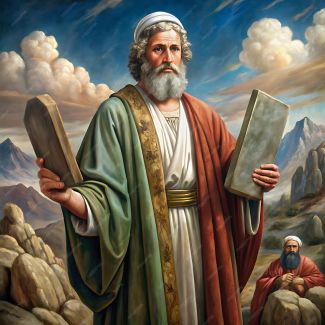

Australian author Mark Robertson wrote The Enlightened Law of Moses, about the Old Testament. Most people think of the Bible in two parts, the Old Testament and the New Testament. And in thinking of the Old Testament, they think of that as the Law of Moses, a collection of old Jewish stories, obsolete statutes, sort of anachronistic, legalistic, and harsh. The New Testament, by contrast, is where all of that is done away, where Christ introduced grace and cast aside Israel to build a better kingdom.
However, we view the Bible as being an integrated whole. That the whole Bible conveys and reveals the narrative arc of God’s plan, and that it is consistent. To a point, some Christian theologians would agree with that story, that the Old and New Testament can be aligned. But the point at which they would typically break is when we start talking about things like keeping the Sabbath or introducing other aspects of law-keeping. And ultimately, most traditional Christians in the world would put us outside the circle of trust, if you would.
They would decide that we have not accepted grace and that we’re at best on the fringe of Christianity from their perspective. So of course, there’s tomes of material written about this subject. But Mr. Robertson calls out a specific idea within this that I found interesting and useful in this context. And that was comparing Jesus Christ and Moses.
So, most people think of Moses in a relationship to law and severity and judgment, and they consider Christ to be a figure who talks about grace and gentleness, and someone who did away with the law of Moses. That’s widely accepted, but it doesn’t comport with scripture.
I’d like to show from scripture that Moses and Jesus were similar characters, holding the same standards and sharing the same purpose, and they both revealed the same God. They just expressed it from different roles and importantly had different jurisdictions.
First consider how God Himself framed Jesus in advance of Christ being manifest as a human being on earth. And this message comes through Moses: “I will raise up for them a Prophet like you from among their brethren, and will put My words in His mouth, and He shall speak to them all that I command Him. And it shall be that whoever will not hear My words, which He speaks in My name, I will require it of him” (Deuteronomy 18:18–19).
Here, God gave Moses a prophecy that He would raise up a prophet at some point later on to be like Moses, someone similar to Moses. And this prophet was so important that God is essentially threatening anybody who would not listen to him. And we might question, because the language is not particularly clear, who is this prophet? But Luke records Peter clarifying exactly who this is in Acts 3. In the verses that lead up to verse 22, Peter says that God fulfilled His prophecies through Christ, and that we should therefore repent and be converted, that He may send Jesus Christ who was preached to you before. And then we see Peter explicitly referencing Deuteronomy 18:18:
“For Moses truly said to the fathers, ‘The Lord your God will raise up for you a Prophet like me from your brethren. Him you shall hear in all things, whatever He says to you. 23 And it shall be that every soul who will not hear that Prophet shall be utterly destroyed from among the people’” (Acts 3:22–23).
So clearly, Peter is making the connection between Christ and the prophet that is spoken of as being raised up in Deuteronomy 18:18. So, this prophet is Christ. God is saying very explicitly through Moses and Peter that Moses and Christ were in fact alike. They’re not dissimilar. However, most Christian philosophy or thought would try to set up a contrast between them. But when you dig in a little bit, you can see that their narratives are very parallel:
- They were both born under national oppression at a time when God was preparing deliverance.
- They were both protected from a king’s decree to kill male children.
- They were both connected in some way to Egypt: Moses came out of Egypt and Christ escaped there from Herod.
- They both performed public miracles as signs of divine authority.
- And they both led Israel out of bondage: One physically and one spiritually.
I had never considered that they had such similarity in their narrative. But they also shared very similar motives and mission in what they were doing. So I’ll just go through a couple of different observations about their character in the Bible and what they did.
Both were motivated by love for the people, not self-interest. You can go back and look at Moses and see that he repeatedly gave up what would have been best for him. He gave up a princely role, and he risked his life for Israel (Exodus 32). Jesus, likewise, gave up His Godhead and His throne, and He gave His life for us. And that’s throughout the Bible, but Isaiah 53 is a good reference point.
Both men carried the burden of an ungrateful and resistant people. Moses endured constant rebellion from Israel under his leadership and complaints against him (Numbers 11). Jesus was rejected and mocked, first only by the leadership, but ultimately by everybody (John 6). But neither man gave up. They proceeded in their purpose.
Both of them spoke the truth plainly, even when it provoked hostility. They did not soften God’s standards to gain popularity, and their authority flowed from obedience to God, not from public approval. Most importantly, they both served an intercessory role, and we’ve certainly seen that in the role of Moses, standing between God and the people. So Moses interceded to preserve Israel from destruction as Christ intercedes to reconcile all of humanity to God the Father.
And they were both humble. Moses is described as being the meekest of men and Christ is described as gentle and lowly in heart. Both the narrative arc and their fundamental character and their persona, their purpose, their mission, those similarities are not coincidental. So, God is working as He does throughout the Bible in dualism to reveal Himself and He’s using both of these prophets to do that. He’s revealing the same God working through two different servants in two different phases of the same plan.
They’re not clearly the same in every way. They’re very distinct beings, but the author of this book, I think, makes a fine point that one of the biggest differences, and maybe where people get confused, is that they had very different jurisdictions. Moses governed a physical nation. He was entrusted with authority over physical people. And so, he did things like governing civil life. He administered judgments and penalties, and he enforced laws. So, there was a whole bunch of civil regulatory activity that was part of his jurisdiction. He certainly functioned as a prophet, but he was also a judge, an administrator, and a governor, and so there was an element of kind of coercive power. He had a way of leading that was a little bit different than the way Christ appeared when He was on earth, and that’s for a specific reason.
Christ refused that kind of authority. He did not take civil authority on Himself at the time. He would not judge civil disputes. He rejected political appointment, which was asked of Him, and He refused to enforce laws or administer penalties. Not because He lacked the authority to do so, but because His jurisdiction was different. And that is highlighted in John 18:36, where he said, “My kingdom is not of this world…”
So I think, this does emphasize the difference between these two figures. Moses exercised authority over a physical nation. His authority was derivative, it was temporary. and he stood for the Lord. So, he was a man in the limited sense of that word, and he represented God to the people. But Christ restrained His authority until His appointed time, and His authority is original and eternal, and He stood as the Lord.
So, they’re not the same, but they are a coherent, logical progression of what God was revealing. Christ did not oppose Moses or the law that Moses wrote down. He brought the law that Moses wrote down to its intended fulfillment. Moses delivered the law as a foreshadowing, while Christ embodied it. He is the law, the manifestation of its grace and truth.
Moses and Christ are linked as a continuum. While many might attempt to set scripture at odds with itself, we can see that God presents the truth as one continuum, one mission, and one unfolding purpose. Moses governed a physical people, and Jesus governs God’s spiritual kingdom. But Moses and Jesus shared the same purpose, the same methods, because they were representatives of that one God and the same plan. And all of scripture is inspired by God and profitable for instruction (2 Timothy 3:16-17).
Staff