
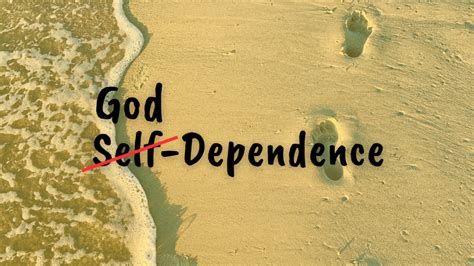

One very consistent failing of all of mankind is a reliance on personal thinking. Self-reliance and the concept of the “self-made man” are marketed as virtues in the world. The narrative suggests that through discipline and effective approaches, man can control his world.
One only needs to walk through a bookstore or get on Amazon and search topics like “leadership” to find book after book on how to be more effective and efficient. How to make oneself more employable. How to become a noteworthy leader. And how to better control our family and work environments.
As followers of Christ called out from this world’s social system, we must do our part to escape the “system”. We must also escape the trap of self-reliance and shift to a state of total God-Dependence. This is of the utmost importance to all of us.
What the world doesn’t tell us regarding our being self-reliant, is that it places a huge burden on every human being. Self-reliance is marketed as both a human and godly virtue, but biblically, it is a spiritual hazard. It represents a shift from trusting our Creator to trusting the “flesh” to handle spiritual issues. Ultimately, self-reliance leads to a burden of exhaustion and turmoil while God-Dependence leads to rest and peace.
Self-reliance establishes a root of pride in us, and it deceives us into believing that any success is the result of our own intelligence and labor, rather than divine guidance and blessings. God explicitly warns against this self-reliant mindset (Deuteronomy 8:12-17).
Self-reliance establishes a root of fear and control based on our apprehension of the unknown. When we assume the burden of sovereignty we use self-reliance to manage fear, yet that fear only drives us toward more self-reliance to remedy the fear. We tend to believe that if we do not control every variable, we are not safe.
Self-reliance also creates a “parched” life of isolation and fragility where one feels alone and broken (Jeremiah 17:5-6), and it instills a persistent illusion of sovereignty. Isolated, fragile: God is quite adamant concerning not trusting our lives to mere men. If we are self-reliant, we are doing exactly that, trusting ourselves, but we are mere men (Psalms 46:3).
Self-reliance deceives us into believing that we possess genuine control over the future and also a sense of absolute autonomy. This mindset prevents us from operating as a faithful agent, one who takes diligent action while confidently leaving the ultimate results to God. James talks about this illusion (James 4:13-15).
Self-reliance also creates a conflict between human metrics, the way we humanly measure our lives, and Godly metrics. We are involved in a conflict between this world’s social order, that metric which is controlled by Satan, and God (Ephesians 6:12). This conflict prioritizes visible outcomes over internal faithfulness.
Despite scriptural warnings to use God’s standards instead of our own, we tend to rely on human metrics more often than we should rather than God’s metrics when judging the successfulness of our lives. Transitioning from human metrics to divine metrics isn’t just a change in philosophy; it is a change in what we define as true, spiritual success in our lives:
- Human Metric of Efficiency vs Godly Metric of Faithfulness
The Human Metric (Efficiency): Self-reliance measures success by following the shortest path that leads to the greatest result. Self-reliance prioritizes speed and output over the process.
The Godly Metric (Faithfulness): God is less concerned with how fast we finish our projects and more concerned with how we conduct ourselves along the way. And often it is totally different from the way we actually planned it. Success is staying at our God given post even when the progress seems slow. That’s called faithfulness (Matthew 25:23, 1 Corinthians 4:2). He is building eternal faithfulness in us.
- Human Metric of Accumulation vs Godly Metric of Stewardship
The Human Metric (Accumulation): Self-reliance measures success by what it collects, what it gathers. It’s about wealth, job titles, social media followers and the assets that it has. It focuses heavily on ownership, possessions, and the accumulation of opportunities.
The Godly Metric (Stewardship): God’s metric is based on how we manage what He has loaned to us. We own nothing; we are simply managers or stewards of whatever it is He gives us (Luke 12:15, 1 Peter 4:10).
- Human Metric of Visibility vs Godly Metric of Humility
The Human Metric (Visibility): Self-reliance measures success by recognition. It operates on the premise that if an action isn’t witnessed, it lacks value. This mindset craves credit, public validation, and the top seat at the table, and that influence is strictly tied to how many people know your name.
The Godly Metric (Humility): God often does His best work in secret. He doesn’t always let us know what’s going on. Success is being willing to be the unseen part of God’s work within the body of Christ. Not desiring the recognition, rather seeking God’s approval over the applause of men (Matthew 6:1-4, Philippians 2:3).
- Human Metric of Control vs the Godly Metric of Trust
The Human Metric (Control): Self-reliance feels successful when it has eliminated risk. It strives to govern the outcome of every situation, operating under the belief that safety depends on the ability to “fix” or “manage” the future. The goal is to eliminate risk by foreseeing everything ahead of time and its possible effects.
The Godly Metric (Trust): God measures success by the ability to remain at peace while relinquishing control to the One who is truly Sovereign. It requires a shift from “I’ve got to fix this “ to “God is handling it” (Proverbs 3:5; Isaiah 26:3).
The Metric Shift
To transition from Self-Reliance to God-Dependence, we must evaluate the standards by which we measure our lives. By contrasting the world’s social Human metrics with the Godly metric standards, we can see how our underlying motivations dictate whether we live in chronic turmoil or whether we actually operate in spiritual rest.
The Burden of Human Metrics:
Relying on our own strength forces us to measure success through Efficiency, a pursuit often fueled by a frantic need for speed or gain that leads to burnout and anxiety. This is frequently paired with a drive for Accumulation; Rooted in a fear of lack, this mindset breeds constant greed and dissatisfaction. There is no contentment. When we seek Visibility, we are driven by pride, which traps us in a wearying cycle of insecurity and comparison: “What does that person think of me? I’m better than him. Look at him.” Ultimately, the desire for Control, born from a fear of the unknown, imposes a paralyzing stress upon us as we struggle to maintain a level of the façade of sovereignty, that we have some type of control that God never designed us to carry in the first place. The spirit in man is not sovereign. God is.
A life of God-Dependence prioritizes Faithfulness, not how fast we do something. And it is driven by a love for God that fosters consistency and purpose. We practice obedient Stewardship, an approach that yields genuine freedom and generosity. Rather than focusing on what we can acquire, we share. Instead of seeking public recognition, we embrace selflessness through Humility, which results in lasting peace and contentment. Instead of attempting to manage every variable, we Trust that God will provide our needs and desires, and the spiritual Rest and assurance that the world’s systems never will provide. By shifting our metrics to God-Dependence, we stop trying to be the “CEO” of our lives.
However, the transition to God-dependence is not a shift where God does everything while we remain passive. It is not a call to laziness, but rather a call to dependent diligence. It means that we intentionally seek to be diligent about staying dependent.
- The Solution: Diligent Dependence
We must remain attached to Christ, our vine (John 15:4-5). We must live by the faith of Christ, not our own faith (Galatians 2:20). And we must place consultation before construction. We often put a plan together and then lay it in front of God and say, “Please bless this.” But in actuality, we need to consult with God first to learn the best way to proceed because His input insures success (Proverbs 19:21).
We must shift our mindset from the burden of believing “I am the safety net” to the profound assurance that “God is the provider” (Matthew 6:31-34, Philippians 4:19). We need to refuse to lean on our own understanding, recognizing that God-Dependency often speaks through the wisdom and perspective of both scripture and godly counselors (Proverbs 3:5, 11:14).
The movement from self-reliance to God-dependency also involves moving away from the exhausting practice of “image management“ to curate how we want others to perceive us. When we stop performing for public validation, we are freed from the trap of people-pleasing and can rest in the approval of God (Galatians 1:10).
Another step in moving from self-reliance to God-dependency is acknowledging our limits and admitting when we are burned out, when we are no longer effective, rather than pushing through on our own power. By stepping back from self-sufficiency, we create a space for God’s power to be “made perfect in weakness”, allowing His divine strength to sustain us where our own capacity fails. God can work His miracles through our weakness (2 Corinthians 12:9).
- The Metric of a Spirit-Dependent Life
This metric is one of Rest. That Rest is about is a profound state of being which is the spiritual byproduct of knowing that we are not the ultimate sustainer of our lives. When we stop viewing ourselves as the safety net and relinquish the illusion of sovereignty, the weight of the future shifts from our shoulders to Christ’s. This allows us to move from the frantic “I must handle this” to the peaceful calm “God is handling this”. Thus, God is fulfilling the promise that His yoke is easy and His burden is light: “Come to Me, all you who labor and are heavy laden, and I will give you rest. Take My yoke upon you and learn from Me, for I am gentle and lowly in heart, and you will find rest for your souls. For My yoke is easy and My burden is light”(Matthew 11:28-30). If we bring God into everything in our lives, He will establish us (Proverbs 16:3). We will have peace. We will have Rest.
When we commit our work to God, our plans are established on a foundation that doesn’t limit us to our own personal capacity. We move from Self-Reliance to God-Dependence, from the human hustle and bustle of everyone going to and fro to the Holy Spirit Momentum, trading our heavy burdens for an “Easy Yoke”. Believing that that yoke is easy is how we move from Self-Reliance to God-Dependence.
He is the foundation that we are to build on: “Unless the Lord builds the house, They labor in vain who build it; …” (Psalm 127:1).
Bill Hutchison